TaxAdhaar: Streamlining Financial Compliance for Modern Businesses
Business
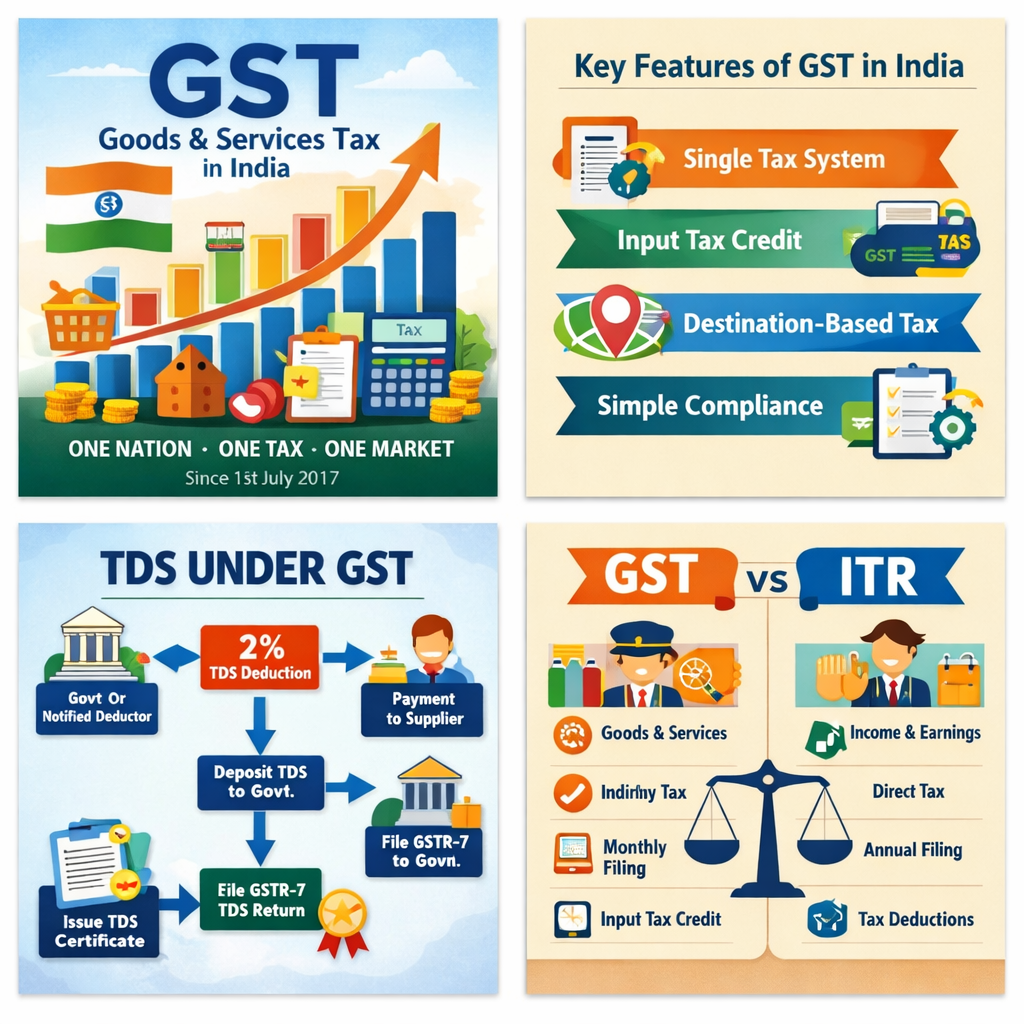
"Goods and Services Tax (GST) is a unified indirect tax levied on the supply of goods and services across India, simplifying earlier tax structures while ensuring taxation at every stage of the supply chain with input tax credits allowed to businesses."
An essential guide for taxpayers and businesses
The Goods and Services Tax (GST) is a comprehensive, multistage, destination-based tax applied on every value addition. Introduced in India on 1 July 2017, GST replaced a range of indirect taxes like VAT, service tax, and excise duties with a unified system that simplifies taxation across states. :contentReference[oaicite:0]{index=0}
GST aims to unify the tax structure, reduce compliance complexity, and allow seamless flow of input tax credits. It is levied at multiple stages of production and distribution and ultimately borne by the end consumer. :contentReference[oaicite:1]{index=1}
An Income Tax Return (ITR) is a form used by taxpayers to report their income, calculate tax liability, and declare deductions, exemptions, and taxes already paid to the Income Tax Department. Individuals, businesses, and companies must file an ITR annually if their income exceeds the prescribed limits.
Filing ITR is mandatory for earning above the taxable threshold. It ensures compliance with income tax laws and helps taxpayers claim refunds if excess tax has been paid. It also acts as proof of income for loans and compliance purposes. Generally, the due date for filing ITR is July 31st of the assessment year, though it may be extended by the government depending on administrative decisions.
TDS stands for Tax Deducted at Source — a system where the payer deducts tax before making certain payments such as salary, interest, commission, or professional fees. The deducted amount is remitted to the Government on behalf of the payee. :contentReference[oaicite:2]{index=2}
TDS ensures timely tax collection and helps widen the tax base by collecting tax at the source of income itself. Under Indian tax laws, deductors must deposit TDS with the government and file quarterly TDS returns, providing details of amounts deducted and paid. :contentReference[oaicite:3]{index=3}
Besides income tax-related TDS, GST also has provisions for TDS under Section 51 of the CGST Act. Certain specified persons (like government authorities and local bodies) deduct TDS while making payments to suppliers. The TDS is calculated on the value of supply excluding GST. :contentReference[oaicite:4]{index=4}
TDS deductors must issue a TDS certificate in form GSTR-7A and file a TDS return (GSTR-7) monthly. GST TDS ensures better compliance and tracking of transactions in the GST ecosystem. :contentReference[oaicite:5]{index=5}
A GST Tax Audit is an examination of a taxpayer’s records, returns, and other documents by the tax authorities to verify compliance with GST laws. Audits help detect discrepancies in tax payments, verify turnover, input tax credit claims, and ensure adherence to GST provisions. :contentReference[oaicite:6]{index=6}
Audits under GST may be conducted at the taxpayer’s place of business or at the tax office. The officer issues a notice at least 15 working days before the audit, and the audit is generally completed within three months from the start date, although extensions are possible. :contentReference[oaicite:7]{index=7}
Once completed, the findings and taxpayer’s rights and obligations are communicated. The audit helps improve transparency, reduce tax evasion, and ensure accurate reporting of GST liabilities. :contentReference[oaicite:8]{index=8}
Staying compliant with GST, ITR, and TDS regulations reduces the risk of penalties and legal issues. Recent enforcement actions show authorities are increasingly vigilant — including crackdowns on fraudulent GST registrations and bogus ITC claims, as well as actions against intermediaries filing false deduction claims in ITRs. :contentReference[oaicite:9]{index=9}
Timely filing, accurate record-keeping, and professional guidance can help taxpayers meet regulatory requirements and avoid disputes with tax authorities.
AimGrit Team Member
Ready to bring your ideas to life? Let's discuss your project requirements.